MANILA, Philippines – The Department of National Defense is hoping to sign up a total of 138 modernization projects for the Armed Forces of the Philippines by July 2012, Secretary Voltaire Gazmin said Friday.
Gazmin told reporters after the launch of Defense Acquisitions System Assessment at Camp Aguinaldo that these projects, worth about P70 billion, would include fighter jets and multi-role vessels.
He added that they would seek to secure a multi-year obligation authority for the projects to be able to enter multi-year contracts that would include the delivery of purchased equipment up to 2020.
These projects will address different concerns like internal security operations and territorial defense.
Starting Saturday, assessment teams will visit different countries to evaluate the equipment that the military needs to acquire.
“Starting tomorrow, marami nang lalabas na mga assessment teams papunta sa mga iba-ibang countries para sa ganun magkaroon sila ng evaluation ng mga equipment na kailangan natin. Kunyari, sabihin natin barko, barko ng europe, barko ng amerikano, barko ng asia, titingnan natin yun ieevaluate natin kung ano yung pinakamagaling at kung ano yung pinaka-affordable sa atin, yun ang uunahin natin, not necessarily sa US,” Gazmin said.
He said the teams would visit the countries which were offering military equipment on sale –Italy, Spain, United States, Korea, France and United Kingdom.

Your never ending news update about your Alma Mater - MSU
Thursday, February 16, 2012


Wednesday, February 15, 2012
Department of Nat'l Defense signs five-year agreement with Italy
 |
| Maestrale class, ASW frigates with 3.100 tonnes displacement and 122.7m in length (photo : Maltashipphotos) |
MANILA, Philippines - The procurement of military equipment from Italy-based suppliers will be fast-tracked under an agreement between the Philippines and Italy.
National Defense Secretary Voltaire Gazmin and Italian Defense Minister Giampaolo Di Paola signed the five-year agreement when Gazmin visited Italy last Jan. 30.
In a statement, Gazmin said the arrangement will help expedite the procurement from Italy of supplies with the help of the Italian Ministry of Defense.
“This arrangement is a result of our efforts to explore any and all avenues for a more efficient procurement process for our modernization program,” he said.
 |
| AMX ground attack aircraft (photo : code20photog) |
The agreement is valid for five years from signing and will be automatically extended for another five years unless there is a written notice of intention to terminate.
However, the signing of the arrangement does not mean that the Philippines would buy defense equipment from Italian firms.
Gazmin said the agreement is merely intended to establish a system for “future transactions.”
Gazmin and members of the DND Defense Acquisition System team left for Italy last Jan. 28 and returned home last Feb. 3.
Other key defense officials who joined the week-long trip were Defense Undersecretary for Finance, Munitions, Installations and Materiel Fernando Manalo, and Bids and Awards Committee chairman Patrick Velez.
 |
| Piaggio P-180 surveillance aircraft (photo : piaggioaero) |
Also inspected were the medium lift tactical aircraft C27J, Italian Navy Coast Watch and Air Defense 3D Radar Systems, AMX ground attack aircraft, unmanned aerial vehicle Falco and armored personnel carrier.
Philippine officials and Italian suppliers also talked about an information technology system that would allow the transmission of data.
The system would allow the delivery of data from any defense material platform to personnel in mission up to the commander-in-chief. The system can enhance the defense awareness of the military and civilians.
 |
| C-27J medium transport aircraft (photo : Aviationnews) |
These are aimed at ensuring the medium- and long-term effectiveness of the equipment that may be bought from Italy.
“We would like to assure the Filipino people that all possible negotiations are premised within the national government’s established ideals of transparency, accountability and good governance,” Gazmin said.
The Philippines has bought 18 basic trainer aircraft from Alenia Aermacchi, an Italian firm that designs and produces military trainers. The delivery of the 18 units was completed last year.
 |
| Falco MALE unmmaned aerial vehicle (photo : Militaryphotos) |
The projects include big-ticket items like fighter jets and long-range patrol aircraft for the Air Force, multi-role vessel for the Navy and coast watch radars.
Aside from Italy, other countries that have offered defense equipment to the DND are the United States, Korea, France and United Kingdom.
from:
Philippine Star
Philippine Sokol Helicopters had arrived


Ordered 8 W-3A units for its Combat Utility Helicopter (CUH) requirement in 2010 at a contract of more than $64 Million, The 1st 4 units were received in February of 2012 with the last 4 scheduled for delivery on the 2nd quarter of 2012
-------------------------------------------------------
-------------------------------------------------------
MANILA, Philippines — The Philippine Air Force (PAF) on Wednesday disclosed the arrival of four brand new Combat Utility Helicopters from the Augusta PZL Swidik of Italy and Poland on February 14, 2012.
The PAF hierarchy said the brand new helicopters arrived at the Clark Air Base in Pampanga, and is the first batch of the eight helicopters that the PAF is to receive from the Polish aircraft manufacturer.
Major General Catalino G. Dela Cruz, PAF Commanding General, said the delivery of the new helicopters is a welcome addition to the fleet of the PAF.
He said that the formal blessing and turnover of the PAF’s newest acquisition will be announced following the completion of assembly and rigid test flights to be conducted on the new helicopters.
According to Lieutenant Colonel Miguel Ernesto G. Okol, PAF Public Information Office director, the “Sokol” or Falcon in Polish, can be fitted with various equipment – depending on the mission – that makes it an ideal utility helicopter for the PAF.
It is NVG (Night Vision Goggle)-capable and is equipped with an SN 350 Autopilot, he added.
Compared to the Huey helicopters, he said the “Sokol” is a more capable utility platform.
Okol explained that while the Huey can carry only seven passengers, the “Sokol” can accommodate 10 passengers with a maximum takeoff weight of 14,110 pounds, an endurance of three hours and 19 minutes, and it can reach a maximum range of 402 nautical miles in a single flight, with airspeed of about 140.5 knots.
The “Sokol” is fitted with gun mounts for the M60D MG on both sides, and when utilized during search and rescue (SAR) or over water operations, it can be equipped with pilot-controlled Emergency Floatation Gear attached to the lowest portion of the aircraft.
It can also perform various missions other than combat to support the country’s peace and development efforts.
“The CUH project is worth P2.8 billion, and has undergone the rigid screening process prior to its procurement,” Okol said.
Monday, February 13, 2012
Philippine Airlines for sale per Lucio Tan who own's 94% of the company's share
 Malacañang on Monday welcomed plans by taipan Lucio Tan to sell national flag carrier Philippine Airlines (PAL).
“We welcome the additional investment of whoever would like to buy PAL because it would mean additional investments to the country,” presidential spokesperson Edwin Lacierda said.
Lacierda said that an additional investment in PAL would mean “improved services.”
“Considering that PAL is our national brand, the additional investment would improve the branding of our national carrier,” he added.
Transportation Secretary Manuel “Mar” Roxas II also said he supported any move that would result in the infusion of fresh capital into PAL, which has struggled against low-cost local carriers over the past decade.
“The government will always welcome more capital in the airline industry in order to strengthen its competitiveness,” Roxas said in a text message.
He said the government would keep its hands off the discussions between private sector stakeholders.
“Who partners with whom is a private matter…so (government) will not micromanage,” said Roxas, a former senator and a senior member of the administration’s economic team.
“Government interest is sufficient capital so that safety and reliability are assured,” he said.
Tan, who owns 94 percent of Asia’s oldest airline, has confirmed reports that he was in the thick of discussions for the sale of PAL with two separate groups—that of San Miguel Corp. and its corporate rival, the group of Manuel V. Pangilinan.
PAL president Jaime J. Bautista has said the firm’s shareholders had long been in search of new investors willing to infuse fresh capital into the airline.
The additional funds would be used to expand the company’s fleet of aircraft and improve its other services.
Bautista himself has denied any knowledge of discussions between PAL’s controlling bloc and either Pangilinan or San Miguel. However, unconfirmed reports earlier this month said Bautista had direct participation in the negotiations.
While San Miguel has confirmed having been approached by PAL to “participate” in the latter’s refleeting program, the Pangilinan group has been mum about it.
Saturday, February 11, 2012

Friday, February 10, 2012
Money in the Philippines you may not know

.jpg)
Quality: Frosted proof
Material: 2.21 troy ounces 900/1000 fine gold
Text on sealed cachet: The 1977 Five Thousand Piso Gold Coin of the Philippines.
The proof coin contained within this sealed cachet was struck by The Franklin Mint on March 24, 1977 the first day of minting of this Proof coin.
Minted under the authorization of the Central Bank of the Philippines by the Franklin Mint, Franklin Center, Pennsylvania, U.S.A.
Signed G.S. Licaros (Governor, Central Bank of the Philippines) and Charles L. Andes (Chairman of the Board, The Franklin Mint).
Obverse: President Ferdinand E. Marcos and First Lady Imelda R. Marcos, The New Society, “V Anniversary”, 1972-1977
-----------------------------------------------------------------------------------------------------

n commemoration of 150th Birth Anniversary of Philippines's national hero Jose Rizal, Bangko Sentral ng Pilipinas minted one peso coin to start "New Generation" coins currency series
-----------------------------------------------------------------------------------------------------


Ten Thousand Peso Commemorative Gold Coin (1992)
6th Anniversary - Restoration of Democracy
Obverse: President Corazon C. Aquino; Republic of the Philippines, 10000 Pesos
Reverse: Philippine map superimposed on Constitution and dove of peace flying towards the light; Democracy Restored; VI Anniversary; 1986, 1992
Shape: round
Edge: reeded
Material: gold
This is the largest coin denomination ever issued in the Philippines. I am still looking for more information on this very rare coin.
-----------------------------------------------------------------------------------------------------


2500 Peso Gold Commemorative Coin – General MacArthur
100th Anniversary of the Birth of General MacArthur
Obverse
Lettering: IKASANDAANG TAONG KAARAWAN
General Douglas MacArthur – 1880-1980
Reverse
Lettering: REPUBLIKA NG PILIPINAS
LEYTE LANDING
OCTOBER 20, 1944
2500 PISO
500/1000
FINE GOLD *
Country : Philippines
Year: 1980
Value: 2500 Piso (2500 PHP)
Metal: Gold (.500)
Weight: 14.57 g
Shape: Round
Orientation: Medal alignment
-----------------------------------------------------------------------------------------------------

Philippine 100,000 Peso-Bill - Guinness Book of World Records Largest Legal Tender
One Hundred Thousand Piso Commemorative Banknote
with BSP Certification of Issuance
Obverse: Cry of Pugadlawin, Philippine Centennial Commission Logo, BSP Logo
Reverse: Declaration of Independence Day
Width: 356mm
Height: 216mm
Pieces Issued: 1000
This banknote was issued during the Centennial of Philippine Independence in 1998. It is as large as a legal-sized bond paper. Produced in Germany, the banknote has 21 security features including a hologram, making it very hard to counterfeit. Today, it is worth many times more. It is recognized by the Guiness Book of world Records as the world's largest legal tender banknote.
The 100,000-peso centennial note, measuring 8.5"x14", is accredited by the Guinness Book of World Records as the world's largest legal tender note in terms of size. 1,000 pieces were issued during the celebration of the centennial of Philippine independence in 1998
-----------------------------------------------------------------------------------------------------


Two-thousand Piso Commemorative Banknote
Obverse: President Joseph Estrada being sworn into office in front of the Barasoain Church in Malolos, Bulacan with his wife Loi Estrada, scroll with the Malolos Constitution, seal of the Central Bank
Reverse: Re-enactment of the proclamation of Philippine Independence at the Aguinaldo Shrine in Kawit, Cavite during the Philippine Centennial Celebration with President Fidel Ramos and his wife Amelita Ramos, Philippine Centennial Commission logo
Length: 216mm
Width:133mm
Composition: 20% abaca, 80% cotton fiber
Pieces Issued: 300,000
Text
Obverse: "Ang panunumpa sa tungkulin ni Pangulong Joseph E. Estrada sa Simbahan ng Barasoain, Malolos, Bulacan, noong ika-30 ng Hunyo, 1998", "Simbahan ng Barasoain, Lunduan ng Unang Demokratikong Republika sa Asya", "Malolos Constitution 1898", "Republika ng Pilipinas", "Dalawang Libong Piso", "Ang salaping ito ay bayarin ng Bangko Sentral at pananagutan ng Republika ng Pilipinas"
Obverse: "Pagdiriwang ng Sentenaryo ng Kalayaan sa Kawit, Cavite na pinangunahan ni Pangulong Fidel V. Ramos nnong ika-12 ng Hunyo, 1998", "Sentenaryong Salapi", "Dalawang Libong Piso"
The security features of this banknote include a 3-dimensional cylinder mould-made portrait watermark of the two presidents, and the years 1898-1998, iridescent band, color-shift windowed security thread, latent image, and perfect see-through register.
-----------------------------------------------------------------------------------------------------
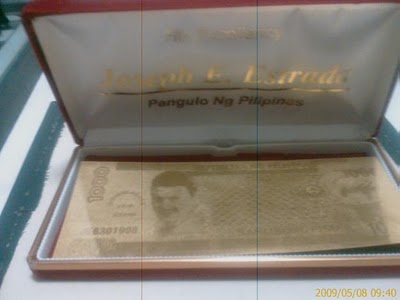

President Joseph "ERAP" Estrada GOLD P1000 Commemorative Bill
This was issued to honor the 100 year celebration of the Philippine Independence. This is an extremely rare collectible given by Erap to his closest relatives and supporters. It's gold plated and features the face of Erap at the front and the back features just like the reverse of the regular P1000 note. It's gold plated and features the face of Erap at the front with the serial number of the bill as JE6301998. It comes with a special case with the seal of the presidency in front and has "his excellency, Joseph Estrada, Pangulo ng Pilipinas" printed inside.
-----------------------------------------------------------------------------------------------------


50 Peso Commemorative Coin (1981)
Pope John Paul II visit to the Philippines
Obverse: Bust of Pope John Paul II, "Papa Juan Pablo II", "Pagdalaw ng Papa sa Pilipinas", 1981
Reverse: , "Lorenzo Ruiz Martir na Pilipino", "50 Piso", "Republika ng Pilipinas"
Material: Silver
Weight: 27.5 grams
Diameter: 39.0 mm
Mintage: 10,000 pcs
-----------------------------------------------------------------------------------------------------
The Republic of the Philippines, an archipelago in the western Pacific 500 miles (805 km.) from the southeast coast of Asia, has an area of 115,830 sq. mi. (300,000 sq. km.) and a population of *64.9 million. Capital: Manila. Migration to the Philippines began about 30,000 years ago when land bridges connected the islands with Borneo and Sumatra. Ferdinand Magellan claimed the islands for Spain in 1521.
The first permanent settlement was established by Miguel de Legazpi at Cebu April 1565. Manila was established in 1572. A British expedition captured Manila and occupied the Spanish colony in October 1762, but returned it to Spain by the treaty of Paris, 1763. Spain held the Philippines despite growing Filipino nationalism until 1898 when they were ceded to the United States at the end of the Spanish-American War. The Philippines became a self-governing commonwealth under the United States in 1935, and attained independence as the Republic of the Philippines on July 4, 1946.
The peso (Filipino: piso) ( code: PHP) is the currency of the Philippines. It is subdivided into 100 centavos (Spanish) or sentimo (Filipino). Before 1967, the language used on the banknotes and coins was English and so "peso" was the name used. The language was then changed to Tagalog (the name of the Filipino language then) and so the currency as written on the banknotes and coins is piso.

The peso is usually denoted by the symbol "". This symbol was added to the Unicode standard in version 3.2 and is assigned U+20B1. Due to the lack of font support, the symbol is often substituted with a simple "P", a P with one horizontal line instead of two (available as the peseta sign, U+20A7 (₧), in some fonts), as "PHP", or "PhP".
+

The Philippine peso was established on May 1, 1852, when the Banco Español-Filipino de Isabel II a (now the Bank of the Philippine Islands) introduced notes denominated in pesos fuertes ("strong pesos", written as "PF"). Until October 17, 1854, when a royal decree confirmed Banco Español-Filipino's by-laws, the notes were in limited circulation and were usually used for bank transactions. The peso replaced the real at a rate of 8 reales = 1 peso. Until 1886, the peso circulated alongside Mexican coins, some of which were still denominated in reales and escudos (worth 2 pesos).
In 1967, the CBP adopted the Filipino language on its currency, using the name Bangko Sentral ng Pilipinas, and in 1969 introduced the "Pilipino Series" of notes in denominations of 1, 5, 10, 20, 50 and 100 piso. The "Ang Bagong Lipunan Series" was introduced in 1973 and included 2-peso notes. A radical change occurred in 1985, when the CBP issued the "New Design Series" with 500-piso notes introduced in 1987, 1000-peso notes (for the first time) in 1991 and 200-piso notes in 2002.

Coin production commenced in 1861 and, in 1864, the Philippines decimalized, dividing the peso into 100 centimos de peso. The peso was equal to 226⁄7 grains of gold. In 1886, Philippine colonial authorities started the gradual phase-out of all Mexican coins in circulation in the Philippines, citing that Mexican coins were by then of lesser value than the coins minted in Manila.
The coins are minted at the Security Plant Complex. Banknotes, passports, seaman's identification record books, land titles, checks, official ballots, official election returns, passbooks, postal money orders, revenue stamps, government bonds and other government documents are printed in the Security Plant Complex or the National Printing Office.
MONETARY SYSTEM
4 Quartos = 1 Real
8 Reales = 1 Peso
--------------------------------------------------------------------------------------
Subscribe to:
Posts (Atom)